
An Introduction
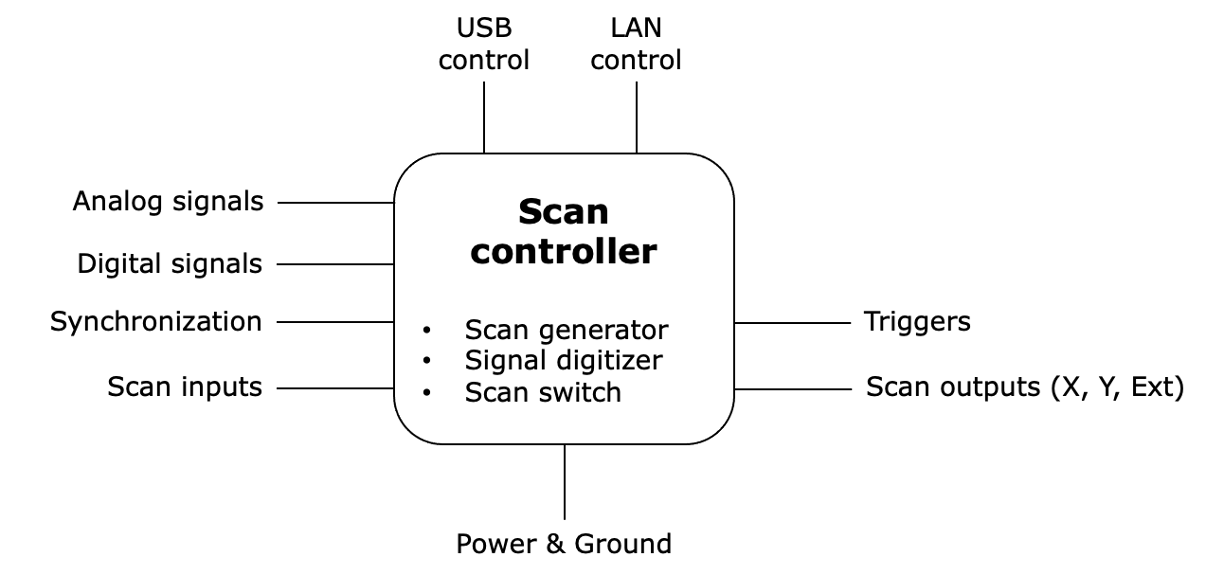
A scan controller is the central real-time control and acquisition unit of a scanning microscope. It generates the precision X-Y signals that steer the beam across the specimen, acquires signals from detectors, coordinates external devices, and transforms physical interactions into digital data products. In practical terms, the scan controller acts as the bridge between the microscope column, detectors, cameras, software, and increasingly, external measurement and automation systems. Devices such as REVOLON and DISS6 integrate scan generation, synchronization, triggering, and signal acquisition into a dedicated hardware platform optimized for microscopy applications.
Historically, scan generation was often implemented as a fixed function within microscope electronics, primarily intended for conventional raster imaging. Modern scientific applications demand significantly greater flexibility. Researchers may need to synchronize fast direct electron detectors, perform sparse or adaptive scanning, collect multiple signals simultaneously, or integrate external instruments into a single experiment. A modern scan controller addresses these requirements by separating scan generation and acquisition from the microscope itself and exposing these functions through programmable interfaces. This transforms the microscope from a closed imaging instrument into a configurable experimental platform.
A modern scan controller is far more than a scan generator. It is the real-time engine that controls beam position, acquires detector data, synchronizes complex instrumentation, and enables advanced experimental workflows. By combining precision hardware, flexible timing, high-speed acquisition, and open software access, scan controllers such as REVOLON and DISS6 transform microscopes into extensible scientific platforms. Open scan control has therefore become a key enabling technology for innovation in electron microscopy, bridging the gap between the physical instrument and the continuously evolving landscape of experimental methods.
Beam Control and Scan Generation
The most fundamental task of a scan controller is to control beam position. It generates highly precise X and Y deflection signals that are sent to the microscope scan electronics and ultimately to the scan coils. These signals determine where the beam is located at every moment during an acquisition. The controller must maintain accurate timing, stable positioning, and repeatable trajectories while operating across a wide range of scan speeds and resolutions.
While traditional microscopy relies on rectangular raster scans, modern controllers support a much wider variety of scan strategies. Arbitrary coordinate lists, point-based scans, sub-pixel scans, sparse scans, and application-specific trajectories can be generated directly by the hardware. The ability to move beyond the raster paradigm has become increasingly important in advanced microscopy, where beam dose, acquisition speed, detector bandwidth, or experimental constraints may require custom scan patterns.
The scan controller also manages pixel dwell time, flyback behavior, scan rotation, magnification, scan offsets, and other parameters that directly influence image quality and acquisition performance. In demanding applications, these parameters must be controlled with sub-microsecond precision to ensure accurate correlation between beam position and acquired data.
Signal Acquisition
Equally important is signal acquisition. As the beam interacts with the specimen, detectors produce analog or digital signals containing information about morphology, composition, crystallography, electrical activity, or other material properties. The scan controller digitizes these signals and associates them with the corresponding beam position to form images or multidimensional datasets.
Modern systems frequently acquire multiple detector channels simultaneously. For example, a single experiment may combine bright-field, dark-field, secondary electron, backscattered electron, cathodoluminescence, X-ray, or electron-counting signals. The scan controller ensures that all channels remain synchronized and spatially aligned. This capability is increasingly important as microscopy moves toward multimodal imaging approaches where different signals are combined to create a more complete understanding of the specimen.
Because acquisition occurs in dedicated hardware, the system can maintain deterministic timing even under demanding operating conditions. This becomes particularly important at high frame rates or short pixel dwell times where software-only solutions may introduce latency or synchronization errors.
Synchronization
One of the defining characteristics of modern scan controllers is their ability to synchronize multiple instruments. Cameras, detectors, beam blankers, spectroscopy systems, sample holders, and external data acquisition devices often need to operate with precise temporal relationships to the beam position. The scan controller serves as the timing master that coordinates these interactions.
This capability has become particularly valuable for 4D-STEM applications. In a typical 4D-STEM experiment, a diffraction pattern is recorded at every probe position, producing datasets that can contain millions of synchronized measurements. Accurate triggering and timing are essential because any mismatch between beam position and detector acquisition directly degrades data quality. Modern scan controllers provide configurable hardware triggers and synchronization signals that allow these systems to operate as an integrated platform.
Similar requirements arise in in-situ microscopy, electrical characterization, electron counting, EBIC, EBAC, and other advanced techniques. In each case, the scan controller provides the timing infrastructure that links beam motion, detector acquisition, and external instrumentation into a coherent experiment.
Open Control
From a system perspective, the scan controller contains a substantial portion of the microscope's functional electronics. Consequently, the degree of access provided by the controller largely determines how easily researchers and developers can introduce new methods and instrumentation.
Open scan control extends beyond simply providing an image acquisition interface. It includes access to beam positioning, timing generation, detector synchronization, triggering, arbitrary scan patterns, and software APIs. When these functions are exposed through documented interfaces, researchers can rapidly prototype new ideas, integrate external hardware, automate complex workflows, and develop entirely new microscopy techniques without modifying the microscope itself.
This approach has become increasingly important as microscopy evolves from a purely imaging discipline into a data-intensive experimental science. Many innovations now originate not from changes to the microscope column, but from new ways of controlling the beam, synchronizing detectors, acquiring data, and processing results. Open scan controllers provide the technological foundation that makes such innovation possible.