
Scope
microDIP is intended for post-processing of microscopy images after acquisition, including metadata embedded in image file header, or separatedpaired metadata files. It supports fully the point electronic GmbH image files and metadata, and only partially data from other sources.
Intended Purpose
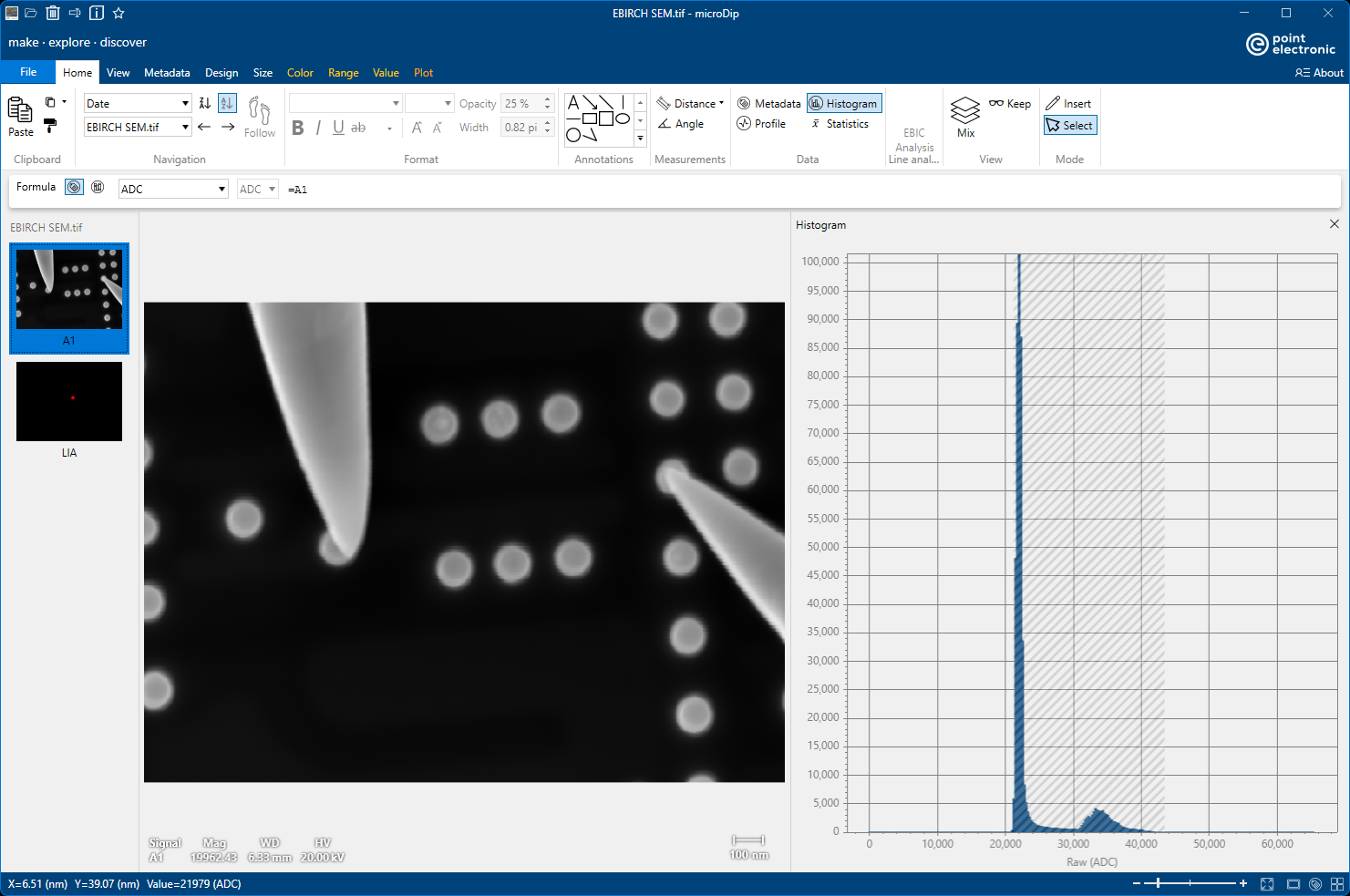
microDIP supports the main post-processing steps required in microscopy, including
- view of image files with multiple simultaneous signals
- view of metadata for each signals
- view of quantitative pixel values
- view of image histogram and statistics
- view of line profiles
- annotation with manual text, arrows, lines, rectangles, ovals
- annotation with automatic info bar, including logo, scale bar and intensity bar
- annotation with measurements of distances and angles, including calibration of pixel size
- processing of grayscale brightness & contrast
- processing of pseudo-colour with palette and gradients
- processing of simultaneous signals into colour (mixing)
- processing of quantitative pixel values with calibration formulas
- navigation between image files in a folder
- export of data to CSV, TIF, PNG and JPEG formats
Supported Datatypes
point electronic GmbH uses open file format where possible. For post-processing TIF files are recommended, but limited post-processing is also available for JPEG files. Metadata is saved in XMP format, embedded into the image file header - for full definition see DISS metadata. Various programming libraries or modules exist to read TIF data and XMP metadata, for example into Python or .NET.
As usual in microscopy, several datatype are possible, where each type fits into an established workflow, therefore microDIP is designed for use with several image datatypes
- multiple-page grayscale 16-bit (TIF)
- multiple-page grayscale 8-bit (TIF)
- multiple-page colour Index8 (TIF)
- multiple-page colour 24-bit (TIF)
- single-page colour 24-bit (JPEG)
Where datatype allows, microDIP will change it's internal algorithms to enable all processing steps for each datatype, however there are limitations. If the original data was compressed, either in JPEG or in a reduced depth of 8-bit, to reduce file size or add colour, then original pixel values are lost and quantification workflows is not longer possible.
Datatype restricts processing after acquisition. If in doubt, acquire in multi-page grayscale 16-bit (TIF)!